
Field Guide · Animal
Appalachian Elktoe
A thin-shelled river mussel of the upper Tennessee basin in western North Carolina and the Nolichucky in Tennessee, whose larvae ride on sculpins.
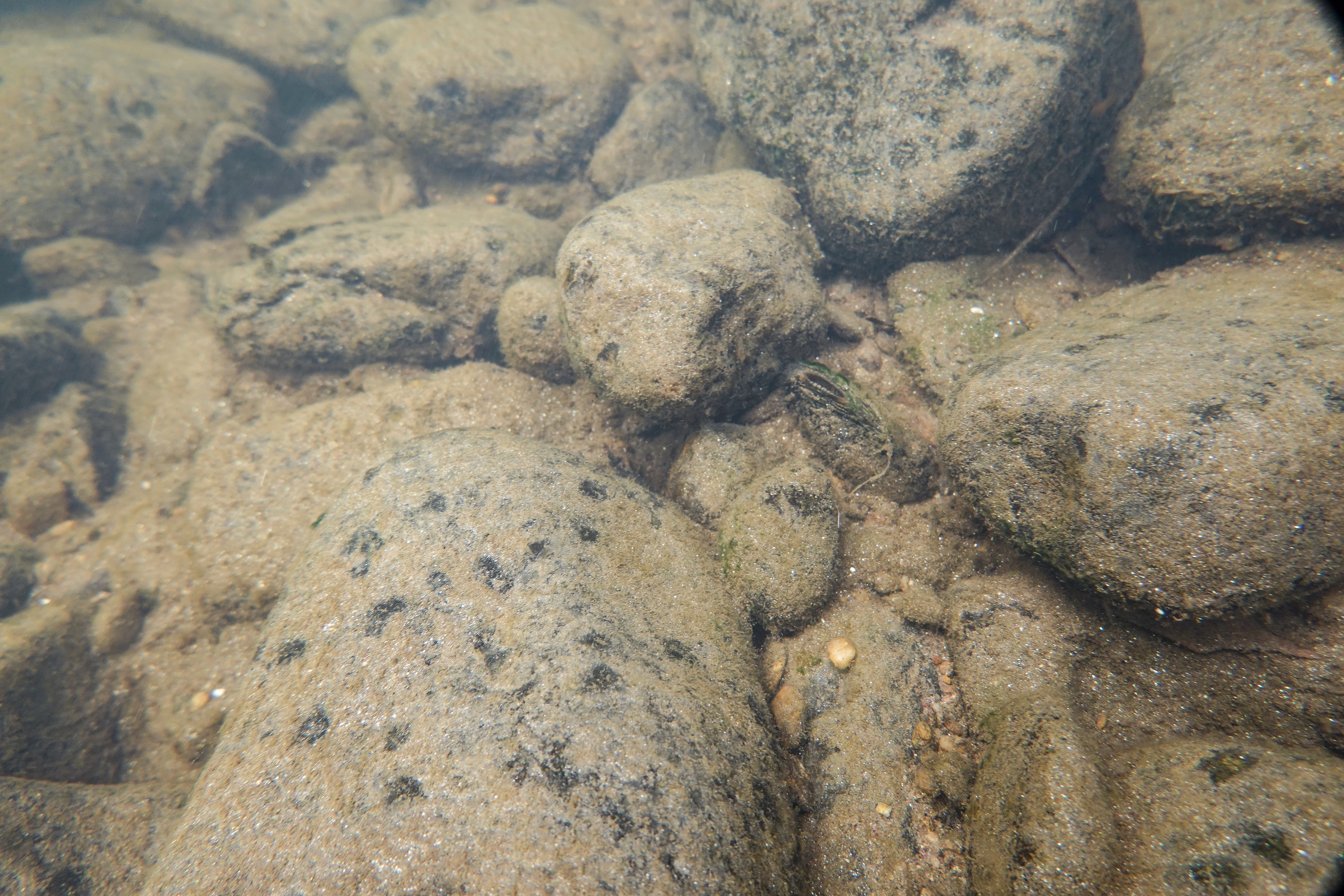
A mountain stream in the Great Smoky Mountains. The elktoe lives in larger rivers outside the park, and a photograph of the mussel is still to come.
- Scientific name
- Alasmidonta raveneliana
- Group
- Freshwater mussel
- U.S. Fish and Wildlife Service
- Endangered, with critical habitat (2002)
- North Carolina Wildlife Resources Commission
- State Endangered
- Documented in
- Little Tennessee River, Tuckasegee River
- Shell
- Thin and kidney-shaped, up to about 4 inches (FWS) or 117 mm (NCWRC)
- Colour
- Yellowish brown when young, dark brown to greenish black as an adult, sometimes with faint green rays. Inside white to bluish white, salmon or pink toward the centre
- Habitat
- Riffles, runs and shallow pools of cool, clean, medium-sized rivers, in stable gravel, cobble and bedrock cracks
- Fish hosts
- Banded sculpin and mottled sculpin
- Rivers
- Little Tennessee, Tuckasegee, Cheoah, Pigeon, Little, Mills and French Broad, and the Toe, Cane and Nolichucky system
- Described
- By Isaac Lea, 1834
What you’d find
Most people who meet an Appalachian elktoe meet an empty shell on a gravel bar. It’s thin and kidney-shaped, up to about four inches by the Fish and Wildlife Service’s measure. Young shells are yellowish brown and adults dark brown to greenish black, and some carry faint green rays toward the back. Inside, the shell is glossy white to bluish white, going salmon, pink or brown toward the centre and up in the beak cavity. The hinge teeth are small and weak.
Live ones sit half-buried in riffles, runs and shallow flowing pools of cool, well-oxygenated, medium-sized rivers, in stable coarse sand and gravel among cobble and boulders or in cracks in the bedrock. They’re seldom found where silt settles or the gravel keeps shifting. If you turn up live mussels, put them back where they were. This one is federally endangered.
Sculpins
Like other freshwater mussels, the elktoe can’t raise its young without a fish. A female holds fertilized eggs in her gills and releases larvae called glochidia, which clamp onto the gills or fins of a host fish for several weeks, without harming it, and then drop off as tiny juveniles. Two hosts are documented. Tennessee Tech researchers identified the banded sculpin in 1993, and the EPA laboratory in Athens, Georgia, the mottled sculpin in 1999. Jim Layzer at Tennessee Tech has lab results for eight more species that carried larvae through, still unpublished and unnamed in the Service’s review. The North Carolina wildlife commission says that under the current sorting of the sculpins, the mottled is the likely host in North Carolina streams. Gravid females have turned up in the Little Tennessee from October to January. Without sculpins in a reach, the mussels there have no way to raise young.
Where it holds on
It once lived in most of the rivers and larger creeks of the upper Tennessee system in North Carolina and in the main Nolichucky in Tennessee. When it was listed as endangered in November 1994, only two populations were known, in the Little Tennessee and in the Toe and Nolichucky. Surveys since have found it in the Tuckasegee and Cheoah, in the Pigeon, Little, Mills and French Broad, and in the North Toe, South Toe and Cane. The North Carolina commission lists it as lost from the French Broad and the Swannanoa, which doesn’t square with the federal list, and the difference is unresolved here.
The Little Tennessee was one of the two original populations. The Service’s five-year review estimated a loss there of at least 70 to 80 percent and reported hundreds of dead mussels below Lake Emory in 2004, cause unknown. Its species page now says that population has functionally disappeared. The remnants of three hurricanes in 2004 scoured the upper Nolichucky system, and in 2008 failures at the Burnsville wastewater plant nearly wiped out the mussels in about nineteen miles of the Cane. Dams, channel work, sediment, wastewater and in-stream mining and dredging are the threats the review names.
Tropical Storm Fred in 2021 and Helene in 2024 both hit the Pigeon. In July 2025 Service biologists searched the East and West forks in Haywood County. They found none in the East Fork and nearly fifty in the West Fork, bunched in a couple of pockets, surviving but not thriving in the Service’s words.
Sources and further reading
- Appalachian elktoe species pageU.S. Fish and Wildlife Service
- Appalachian elktoe 5-Year ReviewU.S. Fish and Wildlife Service, Asheville Ecological Services Field Office (data through 2008)
- Appalachian Elktoe species accountNorth Carolina Wildlife Resources Commission
- Appalachian elktoe surviving but not thriving in streams struck by tropical storms Fred and HeleneGary Peeples, U.S. Fish and Wildlife Service, 28 July 2025