
Field Guide · Animal
Bog Turtle
North America's smallest turtle, living in open mountain bogs and seepage meadows that are disappearing faster than they form.
Dusk over the North Georgia mountains. A photograph of the bog turtle is still to come, and no site will be shown.
- Scientific name
- Glyptemys muhlenbergii
- Group
- Turtle
- U.S. Fish and Wildlife Service
- Threatened due to similarity of appearance (southern population); northern population Threatened
- North Carolina Wildlife Resources Commission
- State Threatened
- Georgia Department of Natural Resources
- State Endangered; state rank S1, global rank G3
- Size
- Shell up to about 4.5 inches
- Look for
- Dark brown to black shell and a bright orange, yellow or red blotch on each side of the head
- Habitat
- Open, sunny, spring-fed wetlands with deep muck, sedge tussocks and sphagnum
- Southern range
- Southwestern Virginia, western North Carolina, east Tennessee, northwestern South Carolina and north Georgia
- Federal status
- Southern population listed in 1997 as threatened by similarity of appearance
- Lifespan
- Matures at 6 to 9 years. Some live more than 60
Small and hard to find
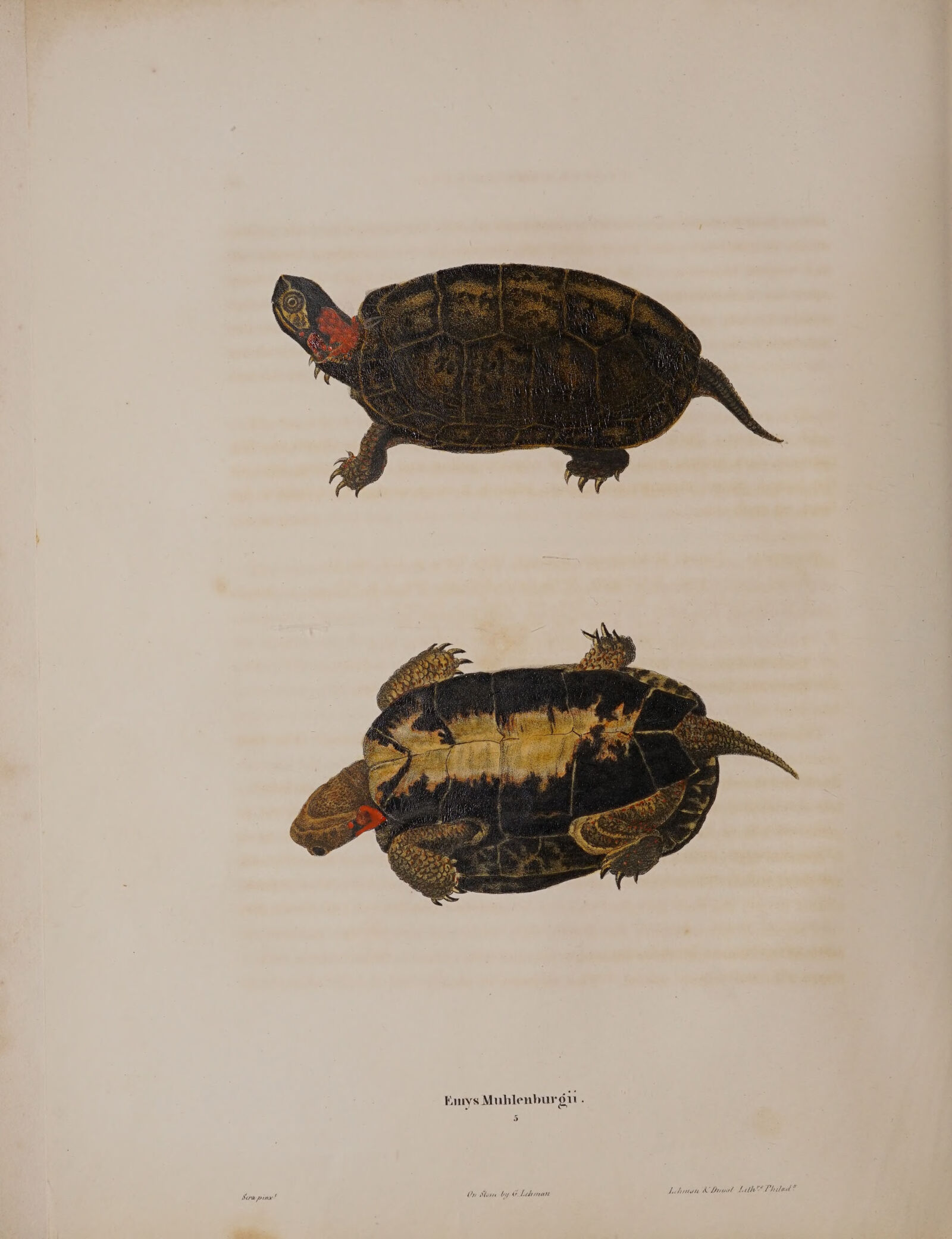
A grown bog turtle fits in a palm. The shell runs about three to four and a half inches, dark brown or black, sometimes with lighter centres or rays on the plates. The giveaway is a bright blotch of orange, yellow or red on each side of the head, behind the eye. The rest of the animal is built for hiding. It spends hot days buried in saturated muck and hibernates from fall to spring, so plenty of people who live beside one never see it.
It lives in open, sunny wetlands fed by springs and seeps: mountain bogs, wet meadows, slow spring creeks, and in western North Carolina some cow pastures and beaver meadows. What it needs is deep, soft, mucky soil, shallow open water, and low sedges, rushes and sphagnum, with tussock sedges to bask and nest on. Georgia’s account says a site can be as small as an acre. Females lay one clutch of one to six eggs a year, often on top of a tussock, and the hatchlings come out in late summer or fall. The turtles take six to nine years to mature, and the Fish and Wildlife Service says some in the wild have lived more than sixty.
The southern population
Bog turtles come in two populations about 250 miles apart. The southern one follows the mountains from southwestern Virginia through western North Carolina, east Tennessee, northwestern South Carolina and north Georgia, with some in North Carolina’s upper Piedmont. Genetic work cited in the Service’s 2022 review finds the two populations distinct. When the Service listed the northern population as threatened in 1997, it listed the southern one as threatened by similarity of appearance. The point was to stop collectors passing off northern turtles as southern ones. A special rule exempts incidental take of southern turtles, so farming or grazing that kills one by accident is not a violation, though the Service said it did not condone destroying their bogs. At the time the Service noted that less than half the likely habitat in North Carolina and Virginia had been surveyed.
North Carolina’s wildlife commission counts fewer than a hundred documented populations in the state. Georgia’s 2011 account knew of eleven sites. At half of them only one turtle had ever been seen, and three populations looked to have been lost to drainage or to woods growing over the bog.
Islands of wet ground
Mountain bogs don’t stay open on their own. Beaver, fire and grazing animals once kept the trees back, and without them shrubs and trees move in and shade the sedges out. Drainage, ditching, ponds, roads and building have taken many of the flat wet bottoms the turtles used, and Georgia’s wildlife division says bogs are disappearing far faster than new ones form. What’s left are small sites with little connection between them, and the Georgia account says intact networks of bogs are now rare across the southern Appalachians. Poaching for the pet trade is a constant worry, which is why nobody publishes where the turtles are. Georgia has raised hatchlings since 2003 and released them into restored bog on national forest land, seventeen by the state’s own count.
Sources and further reading
- Bog turtle species pageU.S. Fish and Wildlife Service
- Final rule to list the northern population of the bog turtle as threatened and the southern population as threatened due to similarity of appearanceU.S. Fish and Wildlife Service, Federal Register 62(213), 4 November 1997
- Bog Turtle (Glyptemys muhlenbergii) 5-Year ReviewU.S. Fish and Wildlife Service, New York Field Office, August 2022
- Bog Turtle species accountNorth Carolina Wildlife Resources Commission
- Bog Turtle species accountT. M. Floyd and J. B. Jensen, Georgia Department of Natural Resources, Wildlife Resources Division, 2007, updated 2011
- Bog Turtle Headstart ProgramGeorgia Department of Natural Resources, Wildlife Resources Division