
Field Guide · Plant
Carolina Hemlock
The southern Appalachian hemlock of dry rock, with needles that stick out all around the twig.
Forested Blue Ridge ridgelines in western North Carolina. A photograph of Carolina hemlock is still to come.
- Scientific name
- Tsuga caroliniana Engelm.
- Group
- Conifer, family Pinaceae
- North Carolina Natural Heritage Program
- Watch List; state rank S2 (lowered from S3 in 2018), global rank G3
- Needles
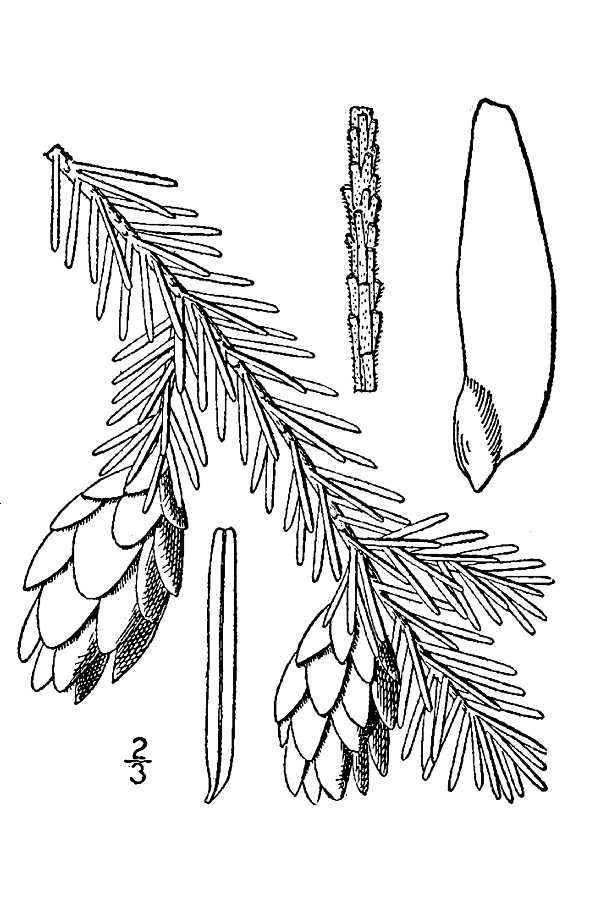
- About 2/3 to 3/4 inch, set every which way around the twig instead of in flat sprays
- Cones
- Averaging over an inch long, larger than eastern hemlock's
- Size
- Usually 40 to 70 feet, with a narrow crown
- Habitat
- Dry, rocky slopes, bluffs and ridgetops, mostly about 2,000 to 5,000 feet depending on the source
- Range
- Southwestern Virginia to northeastern Georgia, most of it in North Carolina and Virginia
- Threat
- Hemlock woolly adelgid, now across the whole range
Telling the two hemlocks apart
Two hemlocks grow in these mountains, and from across a hollow you can’t tell them apart. Walk up to within a few feet. Eastern hemlock lays its short needles out flat on either side of the twig. Carolina hemlock’s needles are a little longer, about two-thirds to three-quarters of an inch, and stick out all around the twig in no particular order, so a branch looks fuller and rounder. The cones help too. Carolina hemlock’s average over an inch, and eastern’s run under an inch. The Forest Service’s fire effects review adds that its seeds are the longest of any native hemlock.
Where it’s growing is the other clue. Eastern hemlock wants cool, wet ground by streams and on shaded slopes. Carolina hemlock takes the dry, rocky, exposed places: bluffs, ledges, ridge crests. Where the two share a slope, as at Linville Falls, the Carolina tree holds the steeper and drier spots, by the North Carolina flora’s account. Jetton and colleagues found it most abundant on dry, north-facing rocky ridgetops between about 600 and 1,500 metres. Mountain laurel, Catawba rhododendron, Carolina silverbell and oaks are among the company it keeps. The fire review says fire probably kills its seedlings and saplings, and that mature stands develop only where fire is rare.
A small range
Carolina hemlock is a southern Appalachian endemic, from southwestern Virginia to the northeastern corner of Georgia, with most of it in North Carolina and Virginia. Jetton’s team put the whole range at about 465 by 165 kilometres. In North Carolina it’s known from every mountain county and is seldom common in any of them. In Georgia, Leslie Edwards of the Georgia Botanical Society lists it among the rare plants of the Tallulah Gorge. A genetic study by Kevin Potter and colleagues found heavy inbreeding in nearly every population and about half the genetic variation lying between populations, which they called highly unusual for a conifer. The same work found it closer kin to Asian hemlocks than to eastern hemlock.
The adelgid
The hemlock woolly adelgid, an insect from Japan, now reaches all of Carolina hemlock’s range, according to Jetton and co-authors in 2013. Badly infested trees can die in four years, though some hang on for ten or twenty. The North Carolina flora says this hemlock is hit less readily than eastern hemlock, which is thin comfort for a tree this scarce, and the state lowered its rank from S3 to S2 in 2018. In five western North Carolina stands studied by Keyser and others in 2023, only three percent of the young stems coming up underneath were Carolina hemlock, and maples dominated the seedlings.
Between 2003 and 2010 the Camcore program collected seed from 134 trees in 19 populations. It’s held in a seed bank in Raleigh and at the USDA’s seed storage centre in Fort Collins, Colorado, and seedlings went into orchards in Ashe County, Chile and Brazil. South America was chosen because it has no native hemlocks to bring the adelgid in.
Sources and further reading
- Account for Carolina Hemlock, Tsuga carolinianaVascular Plants of North Carolina (ncparks.gov)
- Account for Eastern Hemlock, Tsuga canadensisVascular Plants of North Carolina (ncparks.gov)
- Tsuga carolinianaMilo Coladonato, Fire Effects Information System, USDA Forest Service, 1993
- Conserved ex situ genetic resources of eastern and Carolina hemlockR. M. Jetton, W. A. Whittier, W. S. Dvorak and J. R. Rhea, Tree Planters' Notes 56(2), 2013
- Carolina Hemlock Populations: Isolated and Imperiled (on Potter and others, Tree Genetics & Genomes)Kevin Potter, NC State University, 2017
- Composition and structure of Tsuga caroliniana communities in the Southern Appalachian Mountains of western North CarolinaT. L. Keyser and others, Southeastern Naturalist 22(1), 2023
- Tallulah Gorge (as recorded in the Georgia Blue Ridge dossier)Leslie Edwards, Georgia Botanical Society