
Field Guide · Plant
Mountain Golden Heather
A low, needle-leaved shrub of windswept quartzite ledges in the Linville Gorge country, and nowhere else on earth.
Morning mist in the valleys of the Blue Ridge Mountains in North Carolina. A photograph of mountain golden heather is still to come.
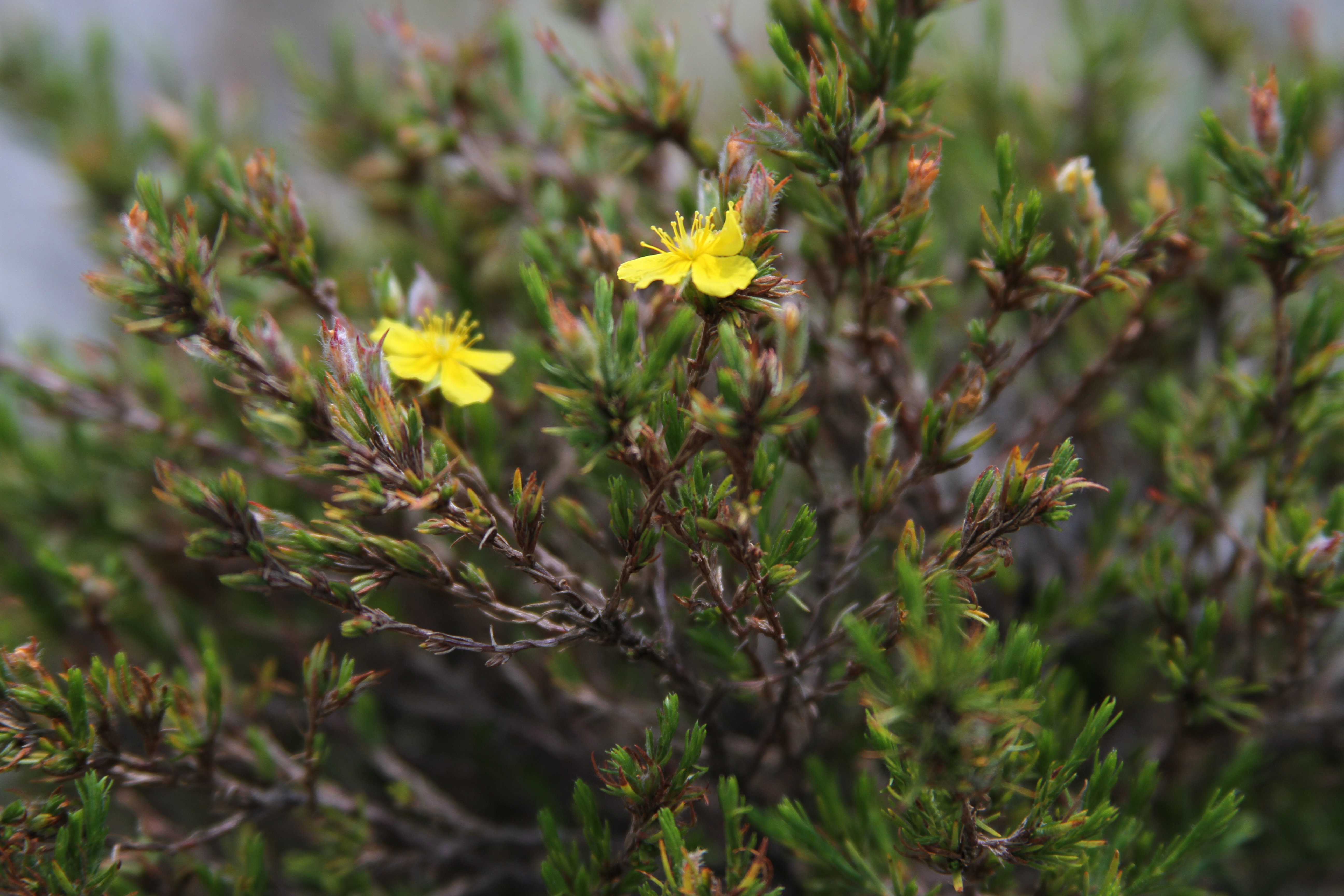
- Scientific name
- Hudsonia montana
- Group
- Shrub
- U.S. Fish and Wildlife Service
- Threatened, with critical habitat
- Documented in
- Linville Gorge, Table Rock Mountain
- Size
- About 3 to 6 inches tall and 6 to 8 inches across
- Leaves
- Small and needle-like
- Flowers
- Yellow, about a quarter inch long (5 to 7 mm, FWS)
- Habitat
- Exposed, windswept quartzite ledges, in the band between bare rock and heath
- Range
- Burke and McDowell counties, North Carolina, in the Linville Gorge area. Six populations
- Count
- 2,947 plants in 2023, down from 10,278 in 2009 (FWS)
What it is
Mountain golden heather is a small, low shrub with needle-like leaves, three to six inches tall and six to eight across by the Fish and Wildlife Service’s 2024 review, and its yellow flowers are only five to seven millimetres long. It grows on bare, wind-scoured quartzite ledges, in the narrow band where open rock gives way to the heath that edges the ledges, which in turn runs into pine and oak forest. The whole species lives in Burke and McDowell counties, North Carolina, in the Linville Gorge area. When the Service listed it in 1980, every population then known lay within about five miles of a single summit.
Those ledges get walked on. Climbers, hikers and campers use the same open rock the plant needs, and the 1980 rule found trampling at every population it knew, plus one large clump partly burned by a campfire. If you’re up on the quartzite in the gorge, keep your boots on bare rock.
Found, lost and found again
Thomas Nuttall collected it in 1816 on the summit of Table Rock and found it abundant there, in wide patches. Later collections were few, and when botanists in the 1960s and 1970s couldn’t find it, some treatments wrote it off as extinct. The 1980 rule reported that the populations known earlier were all still present in 1978. The 2024 review calls the late-1970s finds a rediscovery.
Fire and feet
The Service listed it as threatened on 20 October 1980, effective 19 November, and designated critical habitat in the same rule. The recovery plan of 1983 was written when there were five known populations. There are six now, scattered over 36 separate spots. The counts swing hard: 2,801 plants in 1982, 1,967 in 1993, 10,278 in 2009, 2,947 in 2023. The 2023 census found steep declines in two populations, three spots presumed gone and eleven with no plants seen. The Service says none of its recovery criteria are met, and its 2024 review recommended keeping the species listed as threatened.
Fire has a lot to do with those swings. The work the review cites puts the plant’s needs at a fire every six to eight years and no trampling, and populations have grown after prescribed burns and wildfires, with more seedlings and young plants coming up. Without fire, taller shrubs close over the heather and shade it out. The 1980 rule only guessed that fire might help prepare a seedbed. By 2024 the Service was counting fire suppression as a primary threat, alongside recreation and invasive plants such as princess tree and Chinese silver grass.
Sources and further reading
- Mountain Golden Heather (Hudsonia montana) 5-Year Status ReviewU.S. Fish and Wildlife Service, Asheville Ecological Services Field Office, August 2024
- Determination of Hudsonia montana to be a threatened species, with critical habitatU.S. Fish and Wildlife Service, Federal Register 45(204), 20 October 1980