
Field Guide · Habitat
Spruce-Fir Forest
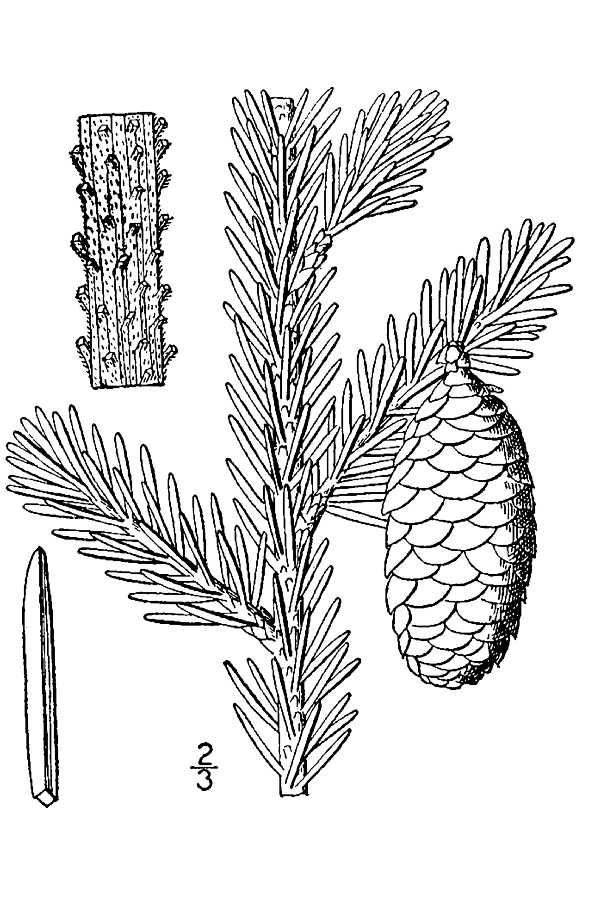
Red spruce and Fraser fir on the highest summits, in a climate as cold as Canada's boreal forest and wetter.
Snow on a spruce at the summit of Roan Mountain, Tennessee.
- North Carolina natural community classification (Schafale 2024), as summarised in the 2025 North Carolina Wildlife Action Plan
- Spruce-Fir Forests theme: Fraser Fir Forest and Red Spruce–Fraser Fir Forest
- U.S. National Vegetation Classification
- Red Spruce - (Fraser Fir) / Rhododendron Forest CEGL007130
- Documented in
- Black Mountains, Grandfather Mountain, Great Balsam Mountains, Great Smoky Mountains, Mount Mitchell, Roan Highlands, Roan Mountain
- Characteristic species
- Carolina Northern Flying Squirrel, Fraser Fir, Red-cheeked Salamander, Spruce-fir Moss Spider
- Where
- Six areas in North Carolina by the state wildlife plan, Grandfather, Roan, the Black and Craggy mountains, the Great Balsams, the Plott Balsams and the Smokies, with the Smokies and Roan reaching into Tennessee
- Elevation
- Generally above 5,500 feet
- Trees
- Fraser fir the only tree in numbers on the highest peaks. Red spruce and yellow birch join it on less severe ground
- Extent
- Estimates run from over 66,000 to over 75,000 acres, depending on the method
- Global rank
- G1, for the association CEGL007130
- Georgia
- None. The EPA's Blue Ridge description places spruce-fir only in Tennessee and North Carolina
What it is
Above about 5,500 feet, by the North Carolina wildlife plan’s figure, the hardwoods give way to conifers. On the highest peaks Fraser fir is the only tree that survives in numbers. On slightly kinder sites red spruce and yellow birch grow with it, and the state’s classification, as the plan summarises it, divides them into Fraser Fir Forest, with herb and rhododendron subtypes, and Red Spruce–Fraser Fir Forest. The plan likens the climate to Canada’s boreal forest for cold and describes it as wetter, with rain and fog gathered on the peaks. The national vegetation classification gives one of these forests, red spruce and fir over rhododendron, a global rank of G1 and finds it best developed between about 5,100 and 6,000 feet, on foggy, saturated ground and acid soils.
Where it is
The wildlife plan lists six areas in North Carolina: Grandfather, the Roan, the Black and Craggy mountains, the Great Balsams, the Plott Balsams and the Smokies. Totals depend on who measured and how, from more than 66,000 acres across the southern Blue Ridge in one estimate to more than 75,000 in North Carolina and Tennessee in another. The Smokies hold most of the red spruce. An Oak Ridge review put the species above roughly 1,200 metres at about 30,500 hectares, more than three-quarters of it inside the park. Georgia has none at all.
What it has come through
Much of what is known about the damage comes from Mount Mitchell. By 1966 the balsam woolly adelgid had killed between 82 and 98 percent of the larger fir in the stands measured there. In the summer of 1986 researchers on the summit measured cloud water as acid as pH 2.2, and another study found the lowest ratios of calcium to aluminium in red spruce needles yet reported from eastern spruce-fir. In the Smokies the Park Service records cloud water down to pH 2.0. The vegetation classification notes that some stands opened by the adelgid have stayed without forest for sixty years or more. On the Roan, Hurricane Helene took an estimated ten to twenty percent of the red spruce canopy in September 2024, by the Forest Service’s first assessment, and replanting has begun.
Sources and further reading
- North Carolina Wildlife Action Plan, section 4.4.3, Spruce-Fir ForestNorth Carolina Wildlife Resources Commission, 2025
- CEGL007130, Red Spruce - (Fraser Fir) / Rhododendron ForestU.S. National Vegetation Classification
- Ecoregions of Tennessee (poster)G. E. Griffith, J. M. Omernik and S. Azevedo, USGS, 1998
- Effects of Acid Deposition on Calcium Nutrition and Health of Southern Appalachian Spruce Fir ForestsS. B. McLaughlin, J. D. Joslin and others, Oak Ridge National Laboratory, c. 1994
- Monitoring the chemical climate of the Mt. Mitchell State ParkV. K. Saxena and others, Tellus B 41, 1989
- Foliar elemental composition of spruce-fir in the southern Blue Ridge provinceW. P. Robarge, J. M. Pye and R. I. Bruck, Plant and Soil 114, 1989
- Air qualityNational Park Service, Great Smoky Mountains National Park, May 2025
- Regeneration of Fraser fir at Mt. MitchellJ. A. Witter and I. R. Ragenovich, Forest Science 32(3)
- 2024 Roan Stewardship UpdatesSouthern Appalachian Highlands Conservancy, 7 November 2024
- ConservationSouthern Appalachian Highlands Conservancy, roanhighlands.org