
Field Guide · Plant
Table Mountain Pine
A stocky pine of hot, rocky ridges whose spiny cones can hang shut on the tree for years.
Dusk over the North Georgia mountains. A photograph of Table Mountain pine is still to come.
- Scientific name
- Pinus pungens Lamb.
- Group
- Conifer, family Pinaceae
- North Carolina Natural Heritage Program
- Global rank G4, North Carolina state rank S4, no state status
- Documented in
- Great Smoky Mountains, The Georgia Blue Ridge
- Cones
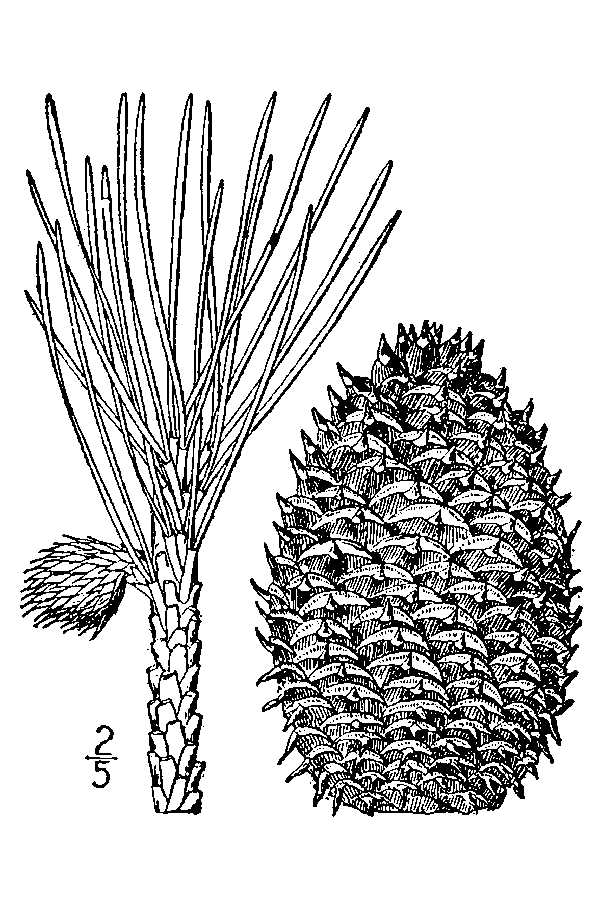
- About 3 inches, heavy and lopsided, each scale tipped with a stout curved spine. Often in whorls, often staying shut
- Needles
- Two to a bundle, sometimes three, stiff and twisted, about 2 inches
- Form
- Usually under 50 feet, crooked and flat-topped on exposed rock
- Habitat
- Steep rocky ridges, cliff edges and outcrops, mostly on south- and west-facing slopes
- Range
- Appalachian endemic, central Pennsylvania to northeastern Georgia
- Also called
- Hickory pine, prickly pine, mountain pine
Know it by the cone
Pick up a Table Mountain pine cone with care. It’s about three inches long, heavy and lopsided, and every scale ends in a thick curved claw sharp enough that the North Carolina flora warns a thrown one can hurt somebody. The cones grow in whorls around the branch and often stay closed for years. The needles come two to a bundle, sometimes three, stiff and twisted and about two inches long. The tree itself is short and stocky, rarely more than fifty feet, and on bare rock it grows crooked with a flattened crown.
Look for it where little else will grow: rocky ridgetops, the lips of cliffs, the edges of outcrops and dry slopes facing south and west, on shallow, stony, acid soil. The Forest Service’s fire effects review puts most stands between 1,000 and 4,000 feet and records it as high as 5,800 feet in the Great Smoky Mountains. Flora of North America gives 500 to 1,350 metres. It’s an Appalachian endemic, from central Pennsylvania to northeastern Georgia. In Georgia, Charles Wharton put it on the ridges off the south face of Rabun Bald, and Leslie Edwards found it dwarfed with pitch pine on the dry rims of Tallulah Gorge.
Fire
Many of its cones are serotinous, sealed with resin until heat opens them. How many varies from tree to tree and stand to stand, and some populations have none. The fire effects review (Reeves 2007) gives the detail. Closed cones can stay on the tree a decade or longer, and seed held in them stays viable for nine to eleven years on average. In one oven test at 210°F every cone had opened within seven and a half minutes. A fire also burns off the litter, bares mineral soil and knocks back the competition. On Bote Mountain in the Smokies, seedling counts after fire rose with severity, from 1,250 per hectare after a light burn to more than 18,000 after a severe one. Fire histories gathered in the review put the old return interval at roughly five to thirteen years in several places, including a mean of 12.7 years in the Smokies between 1856 and 1940.
Without fire
Table Mountain pine needs full sun and does poorly in shade. When fire stays out of a ridge with soil deep enough for hardwoods, oaks move in over a thick understory of mountain laurel, and between the laurel and the oak leaves there’s nowhere left for a pine seedling. Southern pine beetle, which favours this pine, and ice storms push the same direction. The stands that hold on without fire are on bare rock and the driest, most exposed crests, where the litter stays thin. On Looking Glass Rock the botanist Barden found it recruiting steadily for 87 years.
Sources and further reading
- Pinus pungensSonja L. Reeves, Fire Effects Information System, USDA Forest Service, 2007
- Account for Table Mountain Pine, Pinus pungensVascular Plants of North Carolina (ncparks.gov)
- Pinus pungensFlora of North America
- Forests (archived park page)National Park Service, Great Smoky Mountains National Park, 2008
- Natural History of the Georgia Mountains (as recorded in the Georgia Blue Ridge dossier)Charles Wharton, reprinted by Sherpa Guides
- Tallulah Gorge (as recorded in the Georgia Blue Ridge dossier)Leslie Edwards, Georgia Botanical Society